Showing posts with label FEATURE. Show all posts

Saturday, July 2, 2011

Les Diables (The Devils)

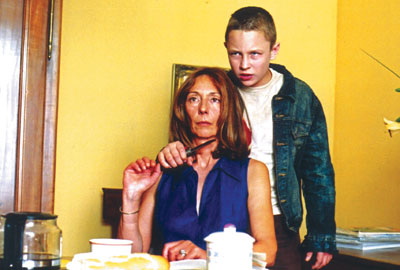
Les Diables: They're no angels....

I didn't think there would be a better film than City of God that juxtaposes children with violence/sex, but here it is - Les Diables (2002).

A disturbing but emotional film, Les Diables follows the brother & sister pair of Joseph and Chloe in an Of Mice And Men like journey to find the elusive dream home that Chloe is able to piece together from broken coloured glass.

Be warned. This is not a feel good film. There are themes of violence, nudity and incest, but that is not the end of it....

The clincher - the two leads are children, underaged and barely hitting puberty. Chloe is autistic and completely incapable of caring for herself, while Joseph is fiercely protective of his sister - to their own detriment. Abandoned from young, they have been continually outcast from a society that fails to treat them with the respect and care that they need.

In consequence, they have wandered from place to place, children's home to children's home - never staying long because the adults cannot understand that Joseph simply will not be kept apart from his sister, and vice versa.

Vincent Rottiers as Joseph; Adele Haenel as Chloe.
Hell hath no fury like a boy on a rampage.
Autistic and in heat.
It is heart wrenching to see how, in a huge and frightening world, how alone the two children are and how much mistrust they have in the adults and society around them. If only they would place their trust in someone!

These are the archetypal 'wild childs' - the 'Devils' that make the film's name.

Homeless, uncontrollable and fearful of social contact, they become a 'Bonnie & Clyde' style wrecking ball, descending into petty crime and anarchy - yet all the while we are painfully aware that it is part of their survival instincts rather than childish willfulness.

Couple that with Chloe's growing sexuality and her discovery for the pleasures of 'touch', plus Joseph's own dim notion of what it means to get too close to one's sister, and we have a controversial and potentially explosive European film.

Innocence lost?
And just what are you thinking, you damn perverts?
Will they ever find a place they can call home?
While not particularly strong in terms of production quality, plus the presence of some incredulously laughable scenes, such as the riot caused by a gang of children - what truly makes Les Diables arresting is the performance of the two leads, Vincent Rottiers as Joseph and Adele Haenal as Chloe. In particular, director Christophe Ruggia's treatment and portrayal of autism is simply oh so poignant and believable.

The film may be violent, but it is not a film about violence. It is about two children trying to find their way in life, trying to survive the harsh realities, all the while still maintaining the innocence that they bear as children.

The final scene may be a little predictable, but it is nonetheless deeply meaningful, and we are left wondering if they have truly at last found the peace and home that they are looking for....


Moometer Reading:
Moo-ooo..?!!

Exclamation for:

! Outstanding Lead Actor: It is a great pity that Adele Haenel was the one to receive the plaudits for her portrayal of an autistic girl, which she admittedly deserves, but in my opinion the true outstanding performer is Vincent Rottiers. In any other setting he would play a cuddly little boy, but here he delivers an out of the world performance as a boy filled with rage and mistrust, yet tentative, fearful and loving (of his sister) at the same time. And there is innocence as well, when his character shares a moment with his sister. His range of emotions are so complete - it is practically the most mature performance I have ever seen coming from a child less than 14 years old. Never mind Hollywood, Vincent Rottiers has set the standard for child actors everywhere.

! Outstanding Direction / Lead Actress: How should I put it? I wouldn't say that Christophe Ruggia has made an outstanding performance as a director. However, when it comes to Adele Haenel's portrayal of an autistic girl, which is yet another out of the world performance, there I have to give credit to the direction. Adele undoubtedly acted very well, and she has gone on to achieve some fame for herself, but her range of expressions are not as complicated as her co-actor. It really isn't that tough to act silly you know. But here, Christophe's own experience dealing with autism I suspect is a huge influence. The portrayal is superb beyond measure. Truly realistic and more so, the portrayal of Chloe's budding sexuality. And I don't mean this in a suggestive way. Indeed, as an adult, you'll be truly alarmed at how Chloe expresses herself, and yet you'll sense that this really is how an autistic child behaves. You have to watch the film to see what I mean. 

Query for:

? Incredulous Riot: When Joseph needs to enter a mental institution to save Chloe, he finds an old ally from a previous children's home, who activates an entire gang of children to break into the institution. Yeah right. What can I say? Viva la France!

Friday, January 21, 2011

Top 10 Chinese Wuxia Films


I had been wanting to do a Top 10 FEATURE article. Indeed, my original idea was to do a Top 10 Samurai Film list, then realised that I hadn't watched quite enough Samurai films yet. At least not enough to ensure the list wouldn't be dominated by Akira Kurosawa & Toshiro Mifune. I suspect it still would eventually, but until then, it will have to be kept in cold storage for now.

Instead, I have decided to start off with a list that would for me be easiest to compile - that of the wuxia genre.

Actually, it's not quite as easy even if I've watched a fair few. But it is one of my favourite genres nonetheless, so it's as good a place to start as any.

The reason why it is not so easy is because I have to make a clear distinction between wuxia and the wider martial arts genre. The problem was that, prior to the 1980s, martial arts choreography in wuxia films were not very different from the general martial arts films. This made it difficult to draw the line especially as most martial arts films were in a kind of period setting.

The special effects of flying, internal energy and explosions only became more visual and prevalent from 1980s on, with director Tsui Hark especially setting the trend with his trademark special effects style.

Wuxia started off as literature, and had been around for centuries. As such, I found myself struggling to decide if films like Jackie Chan's Drunken Fist could be termed as wuxia, which I would of course normally disagree with.

In order to provide the necessary distinction, I came up with a set of rules that a wuxia film should generally adhere to. A wuxia film doesn't necessarily have to adhere to ALL the rules, but at least enough of them to be able to retain the wuxia element in the film.

Rule #1:
There should be an element of fantasy to the martial arts displayed in wuxia films. Although most of these martial arts are grounded in real life martial arts skills, these should be much more exaggerated. Things like using qinggong to fly, dianxue (finger) techniques to immobilise or kill, internal energies to deliver mighty blows and even explosions. For films made before the 'flying' renaissance (pre-1980s), these could be signified by the descriptions of fantastic martial manuals or the use of somersaults and giant leaps over buildings (albeit low ones). This rule thus excludes many of Jackie Chan's kungfu films like Drunken Fist & Snake in the Eagle's Shadow, since the martial arts in those films are simply based on real life kungfu skills, and are not particularly fantastic.

Rule #2:
The wuxia film should take place in a period or historical setting. There may be a few that come very close to modern setting, and thus may be considered an exception. A Man Called Hero is a film set in America close to a modern setting. For this reason, any film set before the world war or in the Manchu Dynasty and before can still qualify as wuxia, though the closer to modern setting, the less likely. So a film like Dragon Tiger Gate (not to be confused with Dragon Gate Inn) cannot be considered wuxia, despite its fantastic martial choreography.

Rule #3:
This rule is a little complex. The characters in a wuxia film should attain a sort of mystical, mythical or legendary heroic (or villainous) status. The story should also as far as possible, take place in the world of Jianghu rather than in the courts or in a war setting. The heroes generally bear no allegiance to the courts (so the Three Kingdoms Classics cannot be termed wuxia), but instead would be affiliated to pugilistic sects and clans or are just simply wandering swordsmen or xiake. There is however a whole subgenre pertaining to court intrigues and starring police constables in lead roles (the recent Detective Dee for example). The reason for this rule is to exclude overly comedic and slapstick films (unless they are spoofs) such as those of Stephen Chow. Kungfu Hustle is thus excluded mainly because of the comedy slapstick, as well as its closeness to the modern setting. Likewise the Flirting Scholar, though Royal Tramp & The Mad Monk can still qualify.

Ultimately however, I had to judge on a film by film basis, giving weightage on the wuxianess of a film depending on the above 3 rules.

A notable exclusion to the genre is Tsui Hark's Once Upon A Time in China series. It no doubt comes close and is of course subjective; but I simply couldn't think of it as wuxia. Huang Feihong is no doubt a legendary Chinese figure. The martial arts displayed in the series is fantastic (Feihong's flying No Shadow Kick). The main problem, I think, is that he's a historical figure. While it is okay to weave wuxia elements around historical figures and events, these should be a backdrop and not the focal point. Put it this way - there have been several Huang Feihong films made over the decades - can all of them be termed wuxia? The wuxia genre has its grounding in literature, so the general basis is that wuxia has to be fantasy fiction.

Anyway, without further ado, here is the Top 10 List of Chinese Wuxia Films that I have had the pleasure of viewing:

__________________________

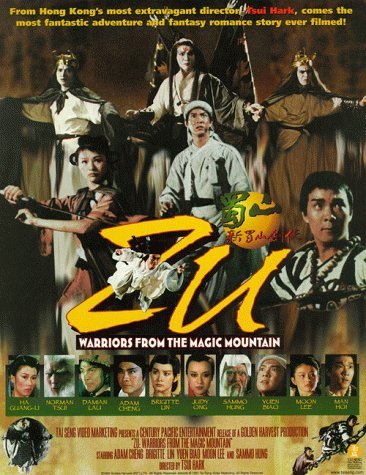
#10. Zu Warriors From The Magic Mountain (1983)
Director: Tsui hark
Starring: Yuen Biao, Adam Cheng, Brigitte Lin Ching Hsia, Samo Hung

Back in those days, Tsui Hark was one of the most innovative special effects directors in Hong Kong. Zu Warriors was one of his first forays into the wuxia genre, a genre in which he would go on to become a trend setter in the use of special effects and wirefu. Here, he effectively combined wuxia with Western special effects technology of the time to create a wonderful fantasy epic of good versus evil.

Though ahead of its time, Tsui Hark somehow got stuck to the 80s-90s mindset, and could never really take the step up into modern CGI technology of today. His CGI heavy The Legend of Zu, a remake of this film, was a failure. His obsession with special effects, which gained him fame early on, seems to now hinder him as he more often than not neglects the storyline in favour of increasingly cheesy effects.

__________________________

#9. Snake & Crane Arts Of Shaolin (1978)
Director: Chen Chi Hwa
Starring: Jackie Chan, Nora Miao

I have to admit that this makes the list almost purely because of Jackie Chan, whom I idolised when I was younger. This film was made before Jackie Chan gained fame as a martial arts comedian.

Nonetheless, I found the storyline, about a mysterious but charming pugilist seeking a mysterious villain by using a top martial arts manual as a lure, to be highly palatable. The ensemble cast of characters is also quite first rate. It doesn't hurt either that the film also stars the very beautiful Nora Miao, in one of her rare pairings with Jackie Chan.

__________________________

#8. Seven Swords (2005)
Director: Tsui Hark
Starring: Charlie Yeung, Leon Lai, Donnie Yen, Kim So-yeon

Seven Swords is a good example of how Tsui Hark can still make a good film if he didn't have to worry about CGI (less said about that the better). With an obvious nod towards Kurosawa's Seven Samurai, here is a good ol' swash buckler featuring seven heroes and their seven unique & fantastical blades.

Good stunt and martial choreography, almost imperceptible wirefu and minus the cheesy effects & explosions of the 90s (that made him famous to begin with) - Tsui Hark stuck to the basics, improving on his strengths while eliminating his weaknesses (those cheesy effects). What he basically did here was to update the wuxia film genre for the new millenium. And for that he is thanked.

__________________________

#7. Come Drink With Me (1966)
Director: King Hu
Starring: Cheng Pei Pei, Yueh Hwa, Chan Hung-Lit

Quite possibly the Citizen Kane of wuxia, this film is widely considered to be one of the best, if not the best, Hong Kong film ever made. Starring the legendary Cheng Pei Pei, who was chosen for the role due to her being a ballet dancer - this film was all about the grace and beauty in martial arts & stunts.

The film became a major influence to martial arts films over the next decades and even up to the modern day, as you will see later.

__________________________

#6. House Of Flying Daggers (2004)
Director: Zhang Yimou
Starring: Zhang Ziyi, Andy Lau, Aniki Jin

This film highlights an oft understated subgenre in wuxia, where the main leads Andy Lau & Aniki Jin play police constables in the imperial court. In the context of the general wuxia world, their status would actually be considered quite lowly - and it shows. Though competent in martial arts, Aniki Jin's and Ziyi's characters tend to struggle against top exponents from both the imperial court and the titular House of Flying Daggers, a secret rebel organisation against the waning Tang Dynasty. This however, gives a thrilling edge to the exquisite fight scenes, where you'll never know who will come out tops.

Director Zhang Yimou is well known for his vivid use of colours, and he certainly doesn't disappoint here. His combination of colour and fight sequences, especially the fight scenes in the bamboo forest, make for some of the most beautiful fight scenes around. Indeed, I wonder if it doesn't deserve a higher ranking on this list - but for now, it stays at #6.

__________________________

#5. The Swordsman (1990)
Producer: Tsui Hark
Starring: Samuel Hui, Cecilia Yip, Sharla Cheung Man, Jacky Cheung

I suspect I'm going to be rapped for choosing this over Swordsman II. It is true that Jet Li relaunched his career with the sequel to this film based on Louis Cha's The Smiling, Proud Wanderer. I would maintain however that Samuel Hui is the best ever Linghu Chong I've ever seen. Chow Yun Fatt, Steve Ma Jingtao & of course Jet Li have variously played the character on TV and film, but it was only Samuel Hui who I felt totally captured the essence of the charismatic & carefree wanderer.

But of course Sam's not the only reason for the film to be on this list. The Swordsman pretty much set the trend for wuxia films in the 90s, with the kind of explosive (literally) special effects and wirefu that wowed audiences throughout Asia. Though somewhat dated in today's context (and thus cheesy), the film holds fond memories for me as it was what introduced the wuxia film genre to me.

If you noticed above, Tsui Hark is listed as the Producer for this film rather than Director. This is because King Hu was originally the director, but in an apparent fallout, he left the project and it was finally wrapped by Tsui Hark.

__________________________

#4. Ashes Of Time (1994)
Director: Wong Kar-wai
Starring: Leslie Cheung, Lin Ching Hsia, Tony Leung Ka-fai, Tony Leung Chiu-Wai, Jacky Cheung, Maggie Cheung, Carina Lau

When famous arthouse auteur Wong Kar-wai turns his attention to wuxia, this is the intriguing result. A film with probably too little 'wuxia' in it, and is better said to be an allegory to love, loneliness & love lost.

More poetic than actually bearing anything resembling a plotline (typical of Wong's films), this story based very loosely on 4 top pugilists from Louis Cha's famed Condor Trilogy, is nonetheless a hypnotic piece of art - to be appreciated rather than to be enjoyed.

Fight scenes are few and often quick and blurry. Normal wuxia fans might well find the pace too slow for their liking. But when you take a look at the impressive cast list - literally a who's who of the Hong Kong industry at the time, then you'll have an idea of the high regard with which Wong Kar-wai is held.

__________________________

#3. Hero (2002)
Director: Zhang Yimou
Starring: Jet Li, Tony Leung Chiu Wai, Maggie Cheung, Zhang Ziyi, Donnie Yen, Chen Daoming

After the unprecedented success in the introduction of the wuxia genre to the United States, director Zhang Yimou followed up with this beautifully made epic of a nameless hero and the stories behind his quest to assassinate the infamous King of Qin.

With more than a hint of Rashomon (Kurosawa again!), Zhang made full use of lush backdrops in different but vivid colour themes (one for each version of essentially the same tale). The result is a cinematographic truimph to behold - a truly spectacular tour de force.

Fight scenes are poetry in motion, with heroes gliding over water or dueling with their minds - all amidst lush sceneries and colour.

Indeed, this film should perhaps have placed just a little higher on this list had it not been for the rather obvious underlying political message - to accept violence and rulership over liberty for the greater good. This film was made in China with government support. And however Zhang may distance himself from criticism, it seems incredible to make a film that would venerate a cruel tyrant in China's history, even if he did unify China.

__________________________

#2. The Storm Riders (1998)
Director: Andrew Lau
Starring: Aaron Kwok, Ekin Cheng, Sonny Chiba

I thought long and hard about this one - 3 weeks in fact - while this article stewed in the vault.

As a film from the last millennium, it is perhaps not as visually beautiful as others we have seen in this past decade. But The Storm Riders is not about beauty in sword fighting - scarcely.

Like The Swordsman, this film based on the popular comic series Fengyun (Wind & Cloud), set a new trend in wuxia or even martial art films. And yet strangely enough, I have yet to see a subsequent wuxia film that has bettered The Storm Riders in terms of actually blending CGI with live action stunts.

That is the crux I think. The Storm Riders practically brought the comic book wuxia genre to live, and was a complete revelation at the time. Imagine seeing the stunts & moves from the comic book being replicated almost faithfully on screen. It was just amazing. And as I said earlier, the blend of CGI and live action is very credible, almost unnoticeable. Unfortunately, this cannot be said of any subsequent Asian film with CGI elements, where the CGI either looks unreal or just completely fail to blend with the rest the film.

To be fair, the 2009 sequel The Storm Warriors should have been technically better, but here the story and execution sucked - so as you can see, CGI is not the only consideration.

All said, had Hero not been so politically nauseating, then The Storm Riders might only have hit #3.

__________________________

#1. Crouching Tiger, Hidden Dragon (2000)
Director: Lee Ang
Starring: Chow Yun Fat, Zhang Ziyi, Michelle Yeoh, Chang Chen

Those already familiar with wuxia films might scoff at this choice for numero uno. Indeed there have apparently been many in Asia who have shrugged off this film, because apparently - there is nothing new here that wuxia fandom hadn't already seen.

Not me. This film may have introduced the world to the wuxia genre, but it is much more than that. Perhaps wuxia fans have come to equate the genre with explosive action and spectacular special effects (and why not indeed - see #2), but here, Lee Ang has reinvented the genre, drawing from the staple wuxia films of the pre-80s (Come Drink With Me was a heavy influence), creating a beautifully crafted film that highlights the best wuxia elements from over the generations passed.

Perhaps part of its success stems from the fact that the film was designed as an introduction to wuxia, and as such the excellent martial arts choreography from Yuen Wo-Ping, who also worked on The Matrix, had to be more realistic while being representative of wuxia. The result is a breathtaking series of martial arts sequences featuring different 'levels' of wuxia - from the rough and tumble of the teahouse sequence (featuring a whole host of exotic Chinese weapons), to the fantastical flying sequences over a bamboo forest (which a professor of mine admitted to being a little over the top).

But perhaps the best fight scenes are between the closely matched characters played by Michelle Yeoh and the sensual Zhang Ziyi. If in Hero, we had poetry in motion, then here we have a vivid and vibrant dance to the matching soundtrack of energetic drumbeats. A truly spectacular display that additionally, makes the best use of wirefu techniques I have ever seen.

And yet, when it comes down to it, Crouching Tiger, Hidden Dragon is not simply a martial arts flick. What truly elevates the film to the level it is at for me - is the underlying story. This is no swashbuckling whack-them-up. The story is beauty & grace - a classic. A hero's journey - except it is a heroine.

Ultimately, the film is about a blossoming young woman who steps out from her aristocratic comforts into the world of Jianghu, and the discovery of how her innocence and willfulness will affect the lives of those around her. There is no real antagonist, though there may be the archetypal villain. It is illuminating perhaps that the villain, played by Cheng Pei Pei, would confess at the end that her goal all along was to kill her protege, the young heroine - all because of a perceived betrayal.

Be it story, choreography or cinematography, Lee Ang has undoubtedly created a masterpiece.


Wednesday, September 9, 2009

FEATURE: Serbis - An explicit view into Filipino cinema

Serbis: Literally an explicit view into Filipino cinema.

What's a day like in a seedy family-run cinema in the Philippines?
---------------------------------------------------------------------------------
Serbis offers precisely this, sometimes all too explicit glimpse into the life of such a family theatre.
---------------------------------------------------------------------------------
We know it is a family theatre because of the big capital letters that line vertically outside the cinema - 'FAMILY'. But the only thing that connotes any kind of kinship in this sleazy joint is the family that runs it.
---------------------------------------------------------------------------------
For hidden within the dark confines of the theatre are a host of activities and characters that are definitely not suitable for the eyes of children.
---------------------------------------------------------------------------------
Run by the Pineda family, all in the name of making a living, the cinema features a glitz of romantic or pornographic films that attract not only prostitutes but also gay young men ready to offer a special "service" to older men.
---------------------------------------------------------------------------------
"Serbis" by the way, means "service" in Tagalog - a byword for the boys hawking their sexual services within the theatre.
---------------------------------------------------------------------------------
Coco Martin as Alan, who is about to get a shock. Let's just say the sex is very real and much more explicit....
---------------------------------------------------------------------------------
Strong performances from Jacky Jose and Gina Pareno as the matriarchs of the family.
---------------------------------------------------------------------------------
The only thing 'Family' about this cinema is the family that runs it.
---------------------------------------------------------------------------------
Those familiar with Filipino film may not be overawed by the live sex scenes that feature all too readily in Serbis. Others however, may find it a little hard to stomach.
---------------------------------------------------------------------------------
But Serbis is not simply a film about the gay culture in the Philippines. It is also a story of the Pineda family that owns the rundown theatre.
---------------------------------------------------------------------------------
But it is not exactly a story either, but rather "a day in the life of"... a revealing look into the various characters that come and go within the dirty, dank halls of the cinema (including a runaway goat no less).
---------------------------------------------------------------------------------
Such films are not easy to appreciate. One does not expect earth-shattering events to occur in the space of a single day. Nor would one expect any suitable conclusions to issues explored within the film.
---------------------------------------------------------------------------------
Instead, Serbis steams along to a slow boil, exposing the lives in detail of a fairly strong ensemble cast.
---------------------------------------------------------------------------------
A matriarchal grandmother (Gina Pareno) breaks her daily routine for a trip to court after suing her estranged husband for bigamy. She leaves her daughter and mother of the family, Nayda (Jacky Jose) to man the theatre in her absence.
---------------------------------------------------------------------------------
Little son Jonas peeps unabashedly at his sister changing. One assumes he would have seen much more in the theatre halls where he seemingly has free rein.
---------------------------------------------------------------------------------
Another son and cinema janitor, Alan (Coco Martin) goes about his daily chores with quiet stoicism, painting murals of nude ladies and clearing choked (and extremely dirty) toilets. He meets with his girlfriend for sex, then warms to the revelation of her unwanted pregnancy.
---------------------------------------------------------------------------------
Nayda's husband Lando (Julio Diaz), who runs a little eatery downstairs, tries to deal with a customer who has shortchanged him.
---------------------------------------------------------------------------------
Meanwhile, cousin Ronald and cinema projectionist (Kristopher King), receives a very visual blowjob from a resident prostitute, then makes eyes at Nayda in a sudden, perhaps incestuous turn....
---------------------------------------------------------------------------------
As a film that offers an unadulterated view into the several seedy cinemas found in the Philippines, Serbis certainly leaves almost nothing to the imagination.
---------------------------------------------------------------------------------
On the other hand, as a drama depicting the lives of people who frequent sleazy settings such as in this cinema, the film is a very frank and thoughtful portrayal. Akira Kurosawa's The Lower Depths this is not, but Serbis does make a decent shout for its sense of realism.
---------------------------------------------------------------------------------
---------------------------------------------------------------------------------
MooMeter Reading:
Moo-oo?!!
---------------------------------------------------------------------------------
Exclaimations for:
! Outstanding Set Design: Carlo Tabije and Benjamin Padero breathe life into the rundown and dilapidated cinema where most of the action takes place. From the lively stairwell filled with wannabe prostitutes whiling their time away in the day, the murky toilet where grandma takes her bath, to the darker interiors of the cinema where a serbis boy jacks off a customer, these scenes make Serbis as much a story about the theatre as it is the about the people who run it.
! Outstanding Cast: Gina Pareno and Jacky Jose deliver very strong performances as the matriarchs of the family. Special mention also for upcoming actor Coco Martin who conveys volumes despite saying very little at all.
---------------------------------------------------------------------------------
Query for:
? Poor Sound Quality: While it is acknowledged that Serbis is a low budget independent arthouse film, and shaky camerawork aside, it is the often overwhelming background noise of traffic that jars the ears rather than to lend a gritty feel to the overall cinematography.

Friday, June 19, 2009

FEATURE: Joint Security Area - Simply the best of its genre....

Lee Byung-Hun, Lee Young Ae and So Kang-Ho as the film's main leads.
Does it look like the hero, villain and fair maiden? Can't be further from the truth....


I've been catching up on a few Korean (ie. South Korean) films lately. These include some of the horror ones, like R-Point, and some of the action thrillers, like The Chaser - both of which were quite highly rated. Suffice to say that Korean films in general are of very high production quality, well scripted, and nearly on par with Hollywood.

Joint Security Area (JSA) is not a horror film, nor is it exactly an action vehicle. Released at the turn of the millenium (2000), it is not a new film either, and does not really boast the best production value - though it is still very good - as is already typical of South Korean films.

I could call it a military thriller - its premise almost a mirror image to Hollywood's Courage Under Fire - except the story and conclusion to JSA has to be infinitely better, as only a tale of two Koreas could be.

Joint Security Area is quite simply the best film of its genre. But then we would have to redefine its genre, because to call JSA a military thriller is akin to calling the former WTC Twin Towers in New York ex-buildings.

A shooting incident in a North Korean border house at the Demilitarised Zone (DMZ) between North and South Korea leaves two North Korean soldiers dead and implicates a South Korean soldier who had escaped from the said border house.

To avoid an already fragile relationship between the North and South escalating into violence, a Neutral Nations Supervisory Commission is called in to investigate and arbitrate a solution. Leading the commission is Major Sophie, a Swiss national of Korean heritage. As she delves deeper into the case, wading through the conflicting accounts from both sides of the border, she discovers that things are not what they appear to be, and must decide for herself what constitutes the truth, and what it is worth in light of the current situation.

Part of the film takes place at the infamous Joint Security Area or Panmunjeom, the only portion of the Korean Demilitarised Zone where North and South Korean forces stand face to face. JSA shows us how seriously both sides can take their duties at this highly sensitive area.

As an investigative thriller, JSA boasts all the usual twists, turns and flashbacks that one might expect, including details on forensic evidence and witness statements.

But what it really is, and what truly sets it apart from your run-of-mill blockbuster, is a touching tale of brotherhood woven into the narrative. So much so, that it becomes a major part of the film.

Think John Woo, complete with [SPOILER ALERT!] a Mexican standoff [SPOILER END] that the famed auteur so perfected, but which JSA has effectively outdone. In fact, in light of the more recent but so disappointing Red Cliff, I would even tell John Woo to "eat your heart out!" to JSA.

Joint Security Area in effect, explores the lives of the isolated men who guard the DMZ on both sides of the border, in the larger backdrop of a volatile political climate that these same men could not understand nor really care for, despite their own loyalties. Major Sophie belongs to that larger backdrop - and her goal is to take that step down, to see things from their own points of view, to understand why the incident had to play out the way it did.

JSA further succeeds because of the way it takes place on several different levels. There are two effective timelines - one exploring the events leading up to the incident, the other emphasises on the investigation. Each major character also has his or her own issues.

But what clinches it for me is actually a twist in the film which has actually confused many in the audience.

I have read several articles where reviewers had questioned the point, even the logic, behind the turn of events. In fact, the twist was never necessary. It was not actually relevant to the larger story, and would have made things easier to understand if it hadn't taken place. Perhaps it was a case of one too many?

Instead, I applaud the director (Park Chan-Wook) for adding that aspect, effectively further humanising the story's main character, yet leaving that question of 'what if' in our minds. As any film maker knows, a good twist needs preparation - a cunningly hidden clue - and it wasn't as if Park hadn't provided one.

In fact, he provided it twice. What it needs however, is understanding and context, which the film will not provide at the time. When Major Sophie interviews Sgt. Lee Soo-Hyeok (Lee Byung-Hun), the alleged shooter and survivor of the incident, she remarks how his comrades had praised him for being a very fast shot. Instead, his reply provides a haunting perpective - that in war, it is not the speed of action that counts, but the steadiness of the mind.

The comment is only so important that it is repeated just once more later in the film, albeit and ironically, by a different person. This single spoiler I impart to you, because it is what is needed to understand the final outcome, and perhaps then you'll see why I recommend Joint Security Area so highly.

Like fine wine that only a connoiseur can appreciate, JSA is a film that takes some getting used to. But like its very final still shot, it hits you suddenly, as it did me. And I know this is one film I will never forget.


MooMeter Reading:
Moo-oo-oo..!!

Exclaimations for:
! Outstanding Film/Storytelling: JSA won awards for Best Film and Best Director, but I'm not quite sure that's it. How to put it? A tremendous tale of brotherhood - how do you award that exactly? Best story for me... script was great too, but just a little suspect....
! Outstanding Final Shot: Those who have seen the film rave about the final end shot. I do too. Worth the price of a ticket, plus very probably the price of the DVD for good measure.

Sunday, May 17, 2009

FEATURE: Love of Siam - A mature film on teen angst and sexuality....

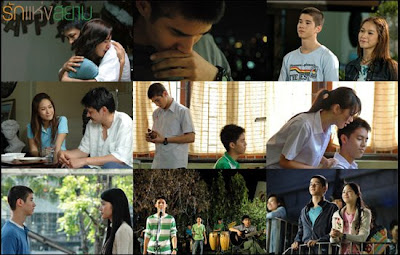
From top left in clockwise: Wiwisit Hiranyawongkul, Kanya Rattanapetch, Aticha Pongsilpipat and Mario Maurer....

I find I always enjoy films that are refreshingly frank and honest in the way they address societal and reality issues.

That, aside from the film's eye candy (of which there are aplenty), I would say is one of the chief strengths in Love of Siam, a 2007 multiple award-winning Thai film.
Tong (Mario Maurer) and Mew (Wiwisit Hiranyawongkul) are boyhood friends who find themselves separated after a tragic disappearance in Tong's family. Years later, while in their teens, Tong and Mew meet up again, both having moved on in their lives. Tong has a very pretty girlfriend, while Mew is an aspiring musician with a successful boyband, August.
Yet neither is fully happy with his life. Tong's family is still struggling to cope with the loss of Tong's missing sister; Mew is finding it hard to find new inspiration for his songs. Their reunion however, helps bring back the memories and forces them (and Tong's family) to come to terms with their respective problems.
Teen drama that tugs on heartstrings....
Four gorgeous teens play starring roles in this romantic teen drama - but Love of Siam isn't just about these four, but also about the people around them, and the sometimes adult issues that face them as they grapple around with their own unadulterated lives.

In fact, what impresses me deeply is how each main character has his or her own storyline/issue fleshed out throughout the film.

It is almost an ensemble cast, each character almost equally good in his/her respective role - though kudos must also go to Sinjai Plengpanich who won Best Actress at the Thai film awards for her role as Tong's mother.

But what clinches it must be the controversial element in the story. I could use just one word to describe this movie, and everyone would understand immediately.

But I find myself agreeing with the producers of the film and director Chookiat Sakveerakul, who touted it a teen romance cum family drama.

Don't let that fool you though - viewers have apparently walked away from cinemas in disgust. There's a reason why this film will never be shown in some countries, including a fairly cosmopolitan and neighbourly Singapore.

Yet despite the controversy, Love of Siam has garnered critical acclaim and dominated the 2007 Thai film awards season - and for good reason.

Indeed, Love of Siam stands out as a drama film in a Thai industry better known for its horror, action or comedy genres.

Let me put it to you straight - it is definitely worth a watch so long as you allow yourself to keep an open mind. After all, it's the least a film - one that doesn't shy from the issues explored in this story - can expect.

MooMeter Reading:
Moo-oo...!!?

Exclaimations for:
! Outstanding Supporting Actress: The Thai Awards seem to recognise (rightfully) serious performances, but Kanya Rattanapetch as a lovelorn but happy-go-lucky schoolgirl is a breath of fresh air....
! Outstanding Theme Song (for your enjoyment below....)
Query for:
? Moovy Revue is not about to reveal the spoiler-worthy controversial element - but you can guess with a little bit of attention... or googling....