Showing posts with label MILITARY. Show all posts

Thursday, September 10, 2009

ANALYSIS: Red Cliff 1 & 2 - Epic commercial blockbuster or unqualified historical disaster?

Red Cliff: An epic of commercial proportions?


The following is an analysis of both Red Cliff instalments as released in Asia.

I would not normally like to touch on movies that I do not like, but there are some that are so awful that it rankles, and I feel the need to make a statement even if everyone else seems to think differently.

As a film critic and producer/director/writer wannabe, there are certain rules that one has to generally accept when reviewing a film.

The first is that movies are inherently flawed. Even with all the attention to detail and continuity, the film is bound to miss a beat somewhere. Then there is the artistic license to change the storyline and plot details to improve viewing pleasure and dramatic impact.

There is no point in scrutinising every little thing just to see if the movie makes sense. If that's what you want, you can visit online forums on the movie or just watch Mythbuster.

The other thing is that film adaptations are generally not as good as the original yarn. As such, it is common for fans and readers of a novel, manga or otherwise to find fault with their respective film adaptations.

The historical epic Red Cliff, directed by John Woo no less, is essentially such an adaptation of the Three Kingdoms' Battle of Red Cliffs.

I'm not going to mince my words. I grew up on Romance of the Three Kingdoms, and I don't like John Woo's version, but that's not the reason I'm breaking the silence.

My beef is with the incredibly flippant motivations and excuses, given by the producers of the two films, for various events written into the storyline.

First they announced that the films would adhere more closely to true historical events - a poorly disguised attempt to give Tony Leung star billing, as if he really needed that (see how well he did in Lust, Caution).

Next they threw in Romance legends of Kong Ming 'borrowing arrows' - a bona fide Mythbuster 'candidate' - effectively making that announcement moot.

Nevermind that.

They needed a stronger female presence, so they threw the beautiful Xiao Qiao (Lin Chiling) right smack into the final confrontation between Cao Cao and the allied forces.

Do we really need to insult the history of Three Kingdoms like that? I can think up a possible dozen extra appearances for Lin Chiling without her having to take centrestage and ruining one of history's great literatures, or records for that matter.
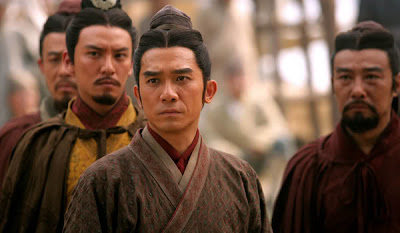
Much ado about Tony: Suddenly the role of Chou Yu takes on a higher plane of importance; though to be fair, Tony Leung plays the part excellently.


They say she can't act: In honesty, she's beautiful enough that she doesn't really need to; but then they made her act the heroine....


Worthy adversary or loyal ally? The chemistry between Takeshi Kaneshiro's Kong Ming and Chou Yu seems a little suspect and sometimes a little contrived.
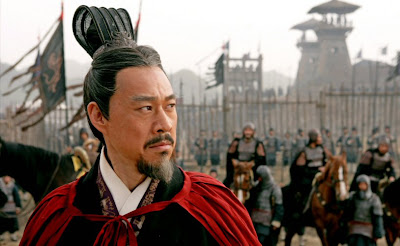

Fallen at the hands of a woman: Zhang Fengyi plays a lecherous Cao Cao who allows a woman to ruin his plans.

Romance of the Three Kingdoms is originally a tale about brotherhood. In that respect, getting John Woo of Bullet in the Head fame to helm Red Cliff seems an inspirational and foolproof choice.

Which is why I find inexplicable that the roles for Liu Bei, Zhang Fei and Guan Yu are so muted, while the best lines seem to fall to Tony Leung's Chou Yu and Takeshi Kaneshiro's Kong Ming.

And it is a two-part epic mind you. No excuses for underdeveloped key characters and storylines.

Chou Yu even gets to be the one to graciously let Cao Cao go scot free. Guan Yu and Kong Ming must be turning in their graves - since it is the former who does so in Romance, while the latter wanted to execute the man who allowed Cao Cao to fight another day.

And finally, though this has more to do with production issues, I would have thought the Chinese had learnt from the failures of Chen Kaige's The Promise and Tsui Hark's The Legend of Zu. Bad CGI just don't cut it in modern blockbusters.

On an added note, wire-fu - especially bad wire-fu - need to be kept off non-wuxia films.

Red Cliff was made with the sole intention to sell popcorn, not to honour the history and tradition of The Three Kingdoms - and a lot of popcorn it did sell.

However, the discerning audience needs to recognise that The Three Kingdoms (Chronicles or Romance) is in itself an epic tale, and the film makers borrowed on that to create a predictably epic and successful two-part movie.

I feel deeply disappointed that an epic story on brotherhood bonds could be so badly reinterpreted by a director like John Woo, who once made his name precisely on films that featured such themes of brotherhood.

MooMeter Reading:
Moo-o..


Friday, June 19, 2009

FEATURE: Joint Security Area - Simply the best of its genre....

Lee Byung-Hun, Lee Young Ae and So Kang-Ho as the film's main leads.
Does it look like the hero, villain and fair maiden? Can't be further from the truth....


I've been catching up on a few Korean (ie. South Korean) films lately. These include some of the horror ones, like R-Point, and some of the action thrillers, like The Chaser - both of which were quite highly rated. Suffice to say that Korean films in general are of very high production quality, well scripted, and nearly on par with Hollywood.

Joint Security Area (JSA) is not a horror film, nor is it exactly an action vehicle. Released at the turn of the millenium (2000), it is not a new film either, and does not really boast the best production value - though it is still very good - as is already typical of South Korean films.

I could call it a military thriller - its premise almost a mirror image to Hollywood's Courage Under Fire - except the story and conclusion to JSA has to be infinitely better, as only a tale of two Koreas could be.

Joint Security Area is quite simply the best film of its genre. But then we would have to redefine its genre, because to call JSA a military thriller is akin to calling the former WTC Twin Towers in New York ex-buildings.

A shooting incident in a North Korean border house at the Demilitarised Zone (DMZ) between North and South Korea leaves two North Korean soldiers dead and implicates a South Korean soldier who had escaped from the said border house.

To avoid an already fragile relationship between the North and South escalating into violence, a Neutral Nations Supervisory Commission is called in to investigate and arbitrate a solution. Leading the commission is Major Sophie, a Swiss national of Korean heritage. As she delves deeper into the case, wading through the conflicting accounts from both sides of the border, she discovers that things are not what they appear to be, and must decide for herself what constitutes the truth, and what it is worth in light of the current situation.

Part of the film takes place at the infamous Joint Security Area or Panmunjeom, the only portion of the Korean Demilitarised Zone where North and South Korean forces stand face to face. JSA shows us how seriously both sides can take their duties at this highly sensitive area.

As an investigative thriller, JSA boasts all the usual twists, turns and flashbacks that one might expect, including details on forensic evidence and witness statements.

But what it really is, and what truly sets it apart from your run-of-mill blockbuster, is a touching tale of brotherhood woven into the narrative. So much so, that it becomes a major part of the film.

Think John Woo, complete with [SPOILER ALERT!] a Mexican standoff [SPOILER END] that the famed auteur so perfected, but which JSA has effectively outdone. In fact, in light of the more recent but so disappointing Red Cliff, I would even tell John Woo to "eat your heart out!" to JSA.

Joint Security Area in effect, explores the lives of the isolated men who guard the DMZ on both sides of the border, in the larger backdrop of a volatile political climate that these same men could not understand nor really care for, despite their own loyalties. Major Sophie belongs to that larger backdrop - and her goal is to take that step down, to see things from their own points of view, to understand why the incident had to play out the way it did.

JSA further succeeds because of the way it takes place on several different levels. There are two effective timelines - one exploring the events leading up to the incident, the other emphasises on the investigation. Each major character also has his or her own issues.

But what clinches it for me is actually a twist in the film which has actually confused many in the audience.

I have read several articles where reviewers had questioned the point, even the logic, behind the turn of events. In fact, the twist was never necessary. It was not actually relevant to the larger story, and would have made things easier to understand if it hadn't taken place. Perhaps it was a case of one too many?

Instead, I applaud the director (Park Chan-Wook) for adding that aspect, effectively further humanising the story's main character, yet leaving that question of 'what if' in our minds. As any film maker knows, a good twist needs preparation - a cunningly hidden clue - and it wasn't as if Park hadn't provided one.

In fact, he provided it twice. What it needs however, is understanding and context, which the film will not provide at the time. When Major Sophie interviews Sgt. Lee Soo-Hyeok (Lee Byung-Hun), the alleged shooter and survivor of the incident, she remarks how his comrades had praised him for being a very fast shot. Instead, his reply provides a haunting perpective - that in war, it is not the speed of action that counts, but the steadiness of the mind.

The comment is only so important that it is repeated just once more later in the film, albeit and ironically, by a different person. This single spoiler I impart to you, because it is what is needed to understand the final outcome, and perhaps then you'll see why I recommend Joint Security Area so highly.

Like fine wine that only a connoiseur can appreciate, JSA is a film that takes some getting used to. But like its very final still shot, it hits you suddenly, as it did me. And I know this is one film I will never forget.


MooMeter Reading:
Moo-oo-oo..!!

Exclaimations for:
! Outstanding Film/Storytelling: JSA won awards for Best Film and Best Director, but I'm not quite sure that's it. How to put it? A tremendous tale of brotherhood - how do you award that exactly? Best story for me... script was great too, but just a little suspect....
! Outstanding Final Shot: Those who have seen the film rave about the final end shot. I do too. Worth the price of a ticket, plus very probably the price of the DVD for good measure.